
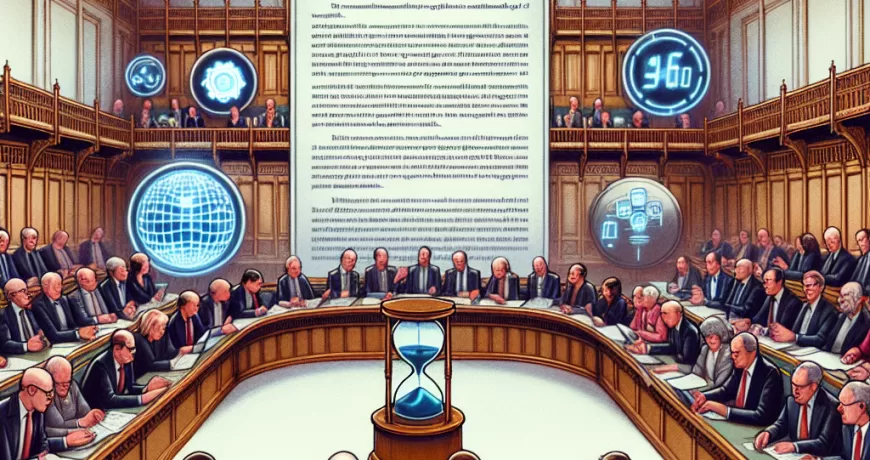
Republicans advocate for a 10-year ban on state AI regulations
The push by Republicans for a decadelong ban on states regulating AI has sparked controversy and concern among various stakeholders. The proposal, included in a budget reconciliation bill submitted by a Republican-led House committee, aims to prevent states from enforcing any law or regulation targeting a broad range of automated computing systems for 10 years after enactment. This move is seen as a gift to Big Tech and could have significant consequences for the public, according to organizations advocating for AI oversight.
The bill, introduced by House Committee on Energy and Commerce Chairman Brett Guthrie, would restrict states from imposing legal impediments on AI models and automated decision systems, which encompass various computational processes that influence or replace human decision-making. This broad definition could impact a wide array of digital services, from search results to health diagnoses, and risk analyses for sentencing decisions.
The proposed moratorium could block over 500 state laws related to AI currently under consideration, covering areas such as chatbot safety, deepfake restrictions, and disclosure requirements for AI in political ads. States like California, Tennessee, and Utah have already implemented laws to safeguard against the misuse of AI, with California’s SB 1047 aimed at imposing security restrictions and legal liability on AI companies.
The lack of federal AI regulation has prompted many states to take the lead in addressing AI-related challenges, such as algorithmic discrimination in housing and criminal justice. The inclusion of the 10-year ban in the reconciliation bill has raised concerns about consumer privacy, deepfake proliferation, and deceptive practices enabled by AI.
Critics argue that the proposal serves as a gift to Big Tech and could hinder innovation by stifling state-level regulation. Democrats have strongly criticized the provision, highlighting its potential negative impact on consumer protections, environmental safety, and marginalized communities. The nonprofit Americans for Responsible Innovation has cautioned against repeating the mistakes made in regulating social media and emphasized the need for responsible oversight of evolving technologies like AI.
While the provision may face challenges in the Senate due to procedural rules, the broader issue of restricting state oversight of AI remains contentious. As AI continues to influence various aspects of society, the debate over balancing innovation with regulation is likely to intensify in the coming years.